A Modest Hero
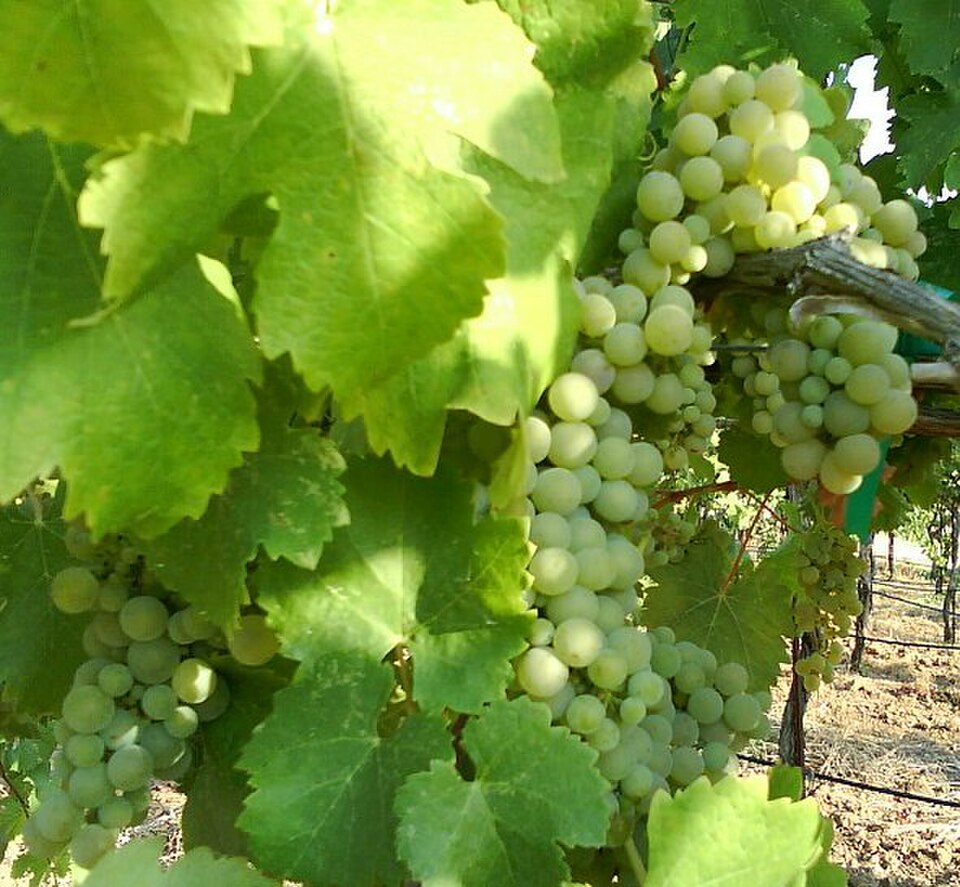
Photo: Viognier grapes on the vine. Courtesy WIkimedia Commons
Georges Vernay was a modest hero. You may have never heard of him, but if you ask the people of Condrieu, France, they'll tell you how he helped bring about the revitalization of their centuries-old wine-making tradition, and helped save their beloved grape from extinction. If you had asked him, he would have told you, "I was just doing my job."
The Grape
Viognier is hardly the most popular grape—the world produces ten times more Sauvignon Blanc, and 30 times more Chardonnay. But the grape is unique, and its wine is valued for it's unique characteristics.
Viognier wine can be bottled with very low sugar content, but it doesn't taste dry because it has a naturally low acidity. It has a generous, silky, creamy texture, and a bold aroma of floral fruits like peach and apricot. The grape is frequently bottled as a single varietal, but is also commonly added not just to white blends but to red blends as well, because it adds a softness to the wine and also creates a more generous nose and more voluptuous flavor.
It's likely that the original home of the Viognier grape was Condrieu, a village in the northern Rhône valley. Farmers have been growing wine grapes in the Rhône valley since at least ancient Roman times. Unfortunately, ancient authors don't tell us what varieties of grape they grew. Viognier is first mentioned in 1781, and in recent history, the valley has also been home to red grapes like Grenache, Syrah, and Mourvèdre, and to whites like Roussanne, Marsanne, and of course Viognier.
Today Condrieu is still Viognier country. One hundred percent of the grapes grown there are Viognier.
Viognier is fussy but the Condrieu terroir suits it perfectly. The vines and grapes are drought-resistant and love a warm, dry climate, but not a hot climate. It grows well in granite-rich soils. It flowers early but grows slowly, and does best with a long growing season. But even when everything goes favorably, the crop can still be difficult.
The banks of the northern Rhône valley around Condrieu are steep and sunny. This helps the grapes ripen, but the work is labor-intensive. The vines are grown on narrow terraces—called chaillées—on the west bank where the vines can catch the southern sun but are protected from the colder north winds. The stone walls of the chaillées absorb heat during the day and release it at night to keep the vines warm. Fissures in the rocky ground help store water to feed the vines.
The chaillées need constant maintenance but are inaccessible to machinery, so that most of the pruning, weeding, and harvesting must be done by hand. The grape is somewhat prone to mildew and rot, and because it ripens late, it's especially susceptible to foraging by birds and animals. This makes it challenging to produce enough grapes with the right combination of perfume, flavor, and alcohol, and to do it profitably.
So when the epidemic devastated French vineyards in the late 1800s and early 1900s, the fields of the Rhône valley, including Condrieu, were vulnerable.
The Plague
Phylloxera vitifolia is a tiny insect related to aphids. It feeds on the roots and leaves of grapevines, deforming the roots and exposing the plants to fungal infections that damage the roots, cut off water, and starve the plant of nutrients. The plague was so extreme that the French government offered a reward to anyone who found a cure for phylloxera. The reward was never claimed. Even today, there is no effective treatment for phylloxera.
The phylloxera epidemic began before 1870. Within twenty years, 40% of the vineyards in France were gone. Attempt at recovery was on and off again, and was further obstructed by the economic turmoil caused by World War I, the Great Depression, and then World War II.
Some farmers tried grafting their crops onto hardier vines that were less susceptible to the disease.
Many farmers converted some or most of their estates to other crops that were more profitable. Cherries, plums, apricots, and lavender could be sold profitably in Paris markets.
Some fields were just abandoned and allowed to grow wild.
In the years after WW2, the wine industry in Condrieu was fading. When Georges Vernay took over the estate of his father Francis in 1953, the vineyard on the estate had been reduced to just a single hectare (2.5 acres). This vineyard was nearly all that was left of Condrieu's wine industry, and may have been the world's entire remaining stock of Viognier grapes. If Vernay had given up, as many other winemakers had done, and shut down or converted his remaining vineyard to other crops, then Viognier would possibly now be extinct.
The Vigneron
But Georges had a vision and passion for his wines. He was convinced of the exceptional nature of his terroir. He believed that his grape could be commercially successful, and that Condrieu soil could unlock the best of Viognier.
So he dedicated his estate entirely to his vineyard. Over time, he cleared the land and replanted all the hillsides with grapes. He set about modernizing his wine-making processes to create a fresher, more modern wine.
He updated his fermentation methods with modern temperature regulation because steady, cool temperatures during fermentation help preserve the volatile aromatic compounds in the wine that give it its bold fruity flavor. It also makes wine production more predictable.
Vernay also pioneered a process of starting fermentation in steel barrels, then transferring to oak barrels
In the years that followed, production of Viognier grew slowly but stubbornly. In 1960, Vernay's single hectare was now seven. By 1986, it had grown to twenty. In 1990, it was up to sixty, and in 2017, the vineyard on Vernays estate had reached 470 hectares of grape.
Revitalization
In 1965, Vernay became the president of the Condrieu growers' association and began working with the other vignerons to reinvigorate the local wine industry. Vernay's influence helped shift the style of Condrieu to focus on freshness and purity as a new generation of vignerons followed his lead.
Vernay also promoted Condrieu's wines outside the valley to leading figures in regional gastronomy. Fernand Point, a chef and restaurateur who has been called the father of modern French cuisine, was an early admirer of Vernay. André Pic, a three-star Michelin chef, stopped by to taste Vernay's wines, was captivated, and helped promoted the wine and make it fashionable.
The relationships that he built connected Condrieu to prestigious consumers willing to take these wines seriously. As Condrieu's Viognier regained a new kind of prestige as one of the world's great white wines, winemakers in other countries took notice and took interest.
Viognier spread through southern France, where almost 9,000 hectares are planted today, and into Italy, which has planted almost 2,000 hectares. American innovators established Viognier in California and Virginia, which now grow about 1,500 hectares. It has been adopted by vineyards in places as widespread as Australia, South Africa, Chile, and Argentina. Today there are around 16,000 hectares in total planted worldwide.
Vernay led a local effort to preserve his beloved grape, but he founded an international movement.
Afterword
It's been suggested that the name Viognier might possibly derive from the Latin Via Gehennae, Road to Hell. Suitably, in 1992, Georges Vernay created a cuvée called Les Chaillées de l'Enfer, The Terraces of Hell, in reference to the many vineyard terraces overlooking the Rhône.
In 1996, Georges handed the reins of the estate, Domaine Vernay, over to his daughter Christine. She has established a reputation for herself as another of the great winemakers. La Revue du Vin de France awarded her three stars for her wines, their highest award.
Georges would spend his days working in his vegetable garden. He passed away in 2017. Obituaries called him "The Pope of Condrieu" and "The Savior of Viognier".
In retrospect, Georges Vernay's real garden was the whole of Condrieu, and even, maybe, the world. The garden he planted survives him. It enjoys the admiration of Viognier lovers worldwide, and the gratitude and respect of the citizens and vignerons of Condrieu.